Marine life
Why does the whale shark arrive in the Bay of La Paz in these months?
Every winter, juvenile whale sharks gather at the southern end of the bay. Science points to food and temperature, though not everything is settled.
The biggest fish in the world, just passing through
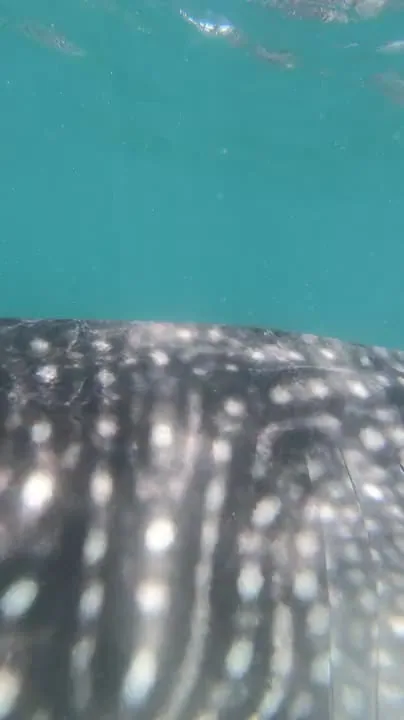
The whale shark (Rhincodon typus) is the largest fish alive, and despite its size it feeds by filtration: it swims with its mouth open and uses rake-like structures on its gills to trap plankton, small fish and crustaceans. The IUCN Red List classifies it as Endangered.
Unlike a whale, it is not a mammal — it is a shark, and one of the few that feeds almost exclusively on tiny organisms.
When and where does it show up in La Paz?
In the Bay of La Paz, the species is not spread evenly through the year. A study analyzing twelve years of records (2003-2015), collected by the NGO Whale Shark Mexico, found that juvenile aggregations concentrate in the southernmost part of the bay and reach their highest abundance between November and January.
The same study found that sea surface temperature matters: a preference close to 24°C was linked to significantly more sightings per day.
A hypothesis: food before temperature
Why gather right there, and then? The hypothesis the same study raises is that the aggregation is tied to zooplankton blooms in the bay, which the sharks might detect through olfactory cues. It is a reasonable hypothesis, not a proven fact — the study itself presents it as an observed association, not yet tested experimentally.
A later study, published in 2020 in the Revista Mexicana de Biodiversidad, found that the sharks’ feeding behavior occurs when zooplankton concentration is higher, with a preference for dense patches of copepods and chaetognaths in the shallow, turbid waters near the El Mogote sandbar.
A refuge area with rules, not just an attraction
Since November 2019, the Bay of La Paz has had a Refuge Area for the protection of the whale shark, published in Mexico’s Official Gazette (Diario Oficial de la Federación). Its management plan — renewed by CONANP every season — divides the area into three zones: Zone I for observation and swimming without touching the animal, Zone II for conservation, and Zone III for vessel transit.
The rule is specific: if five individuals or fewer are detected in Zone I, CONANP must suspend the observation activity until further notice. This is not just theory — recent years have seen real suspensions due to low shark numbers, as happened in February 2023.
What this means for a trip
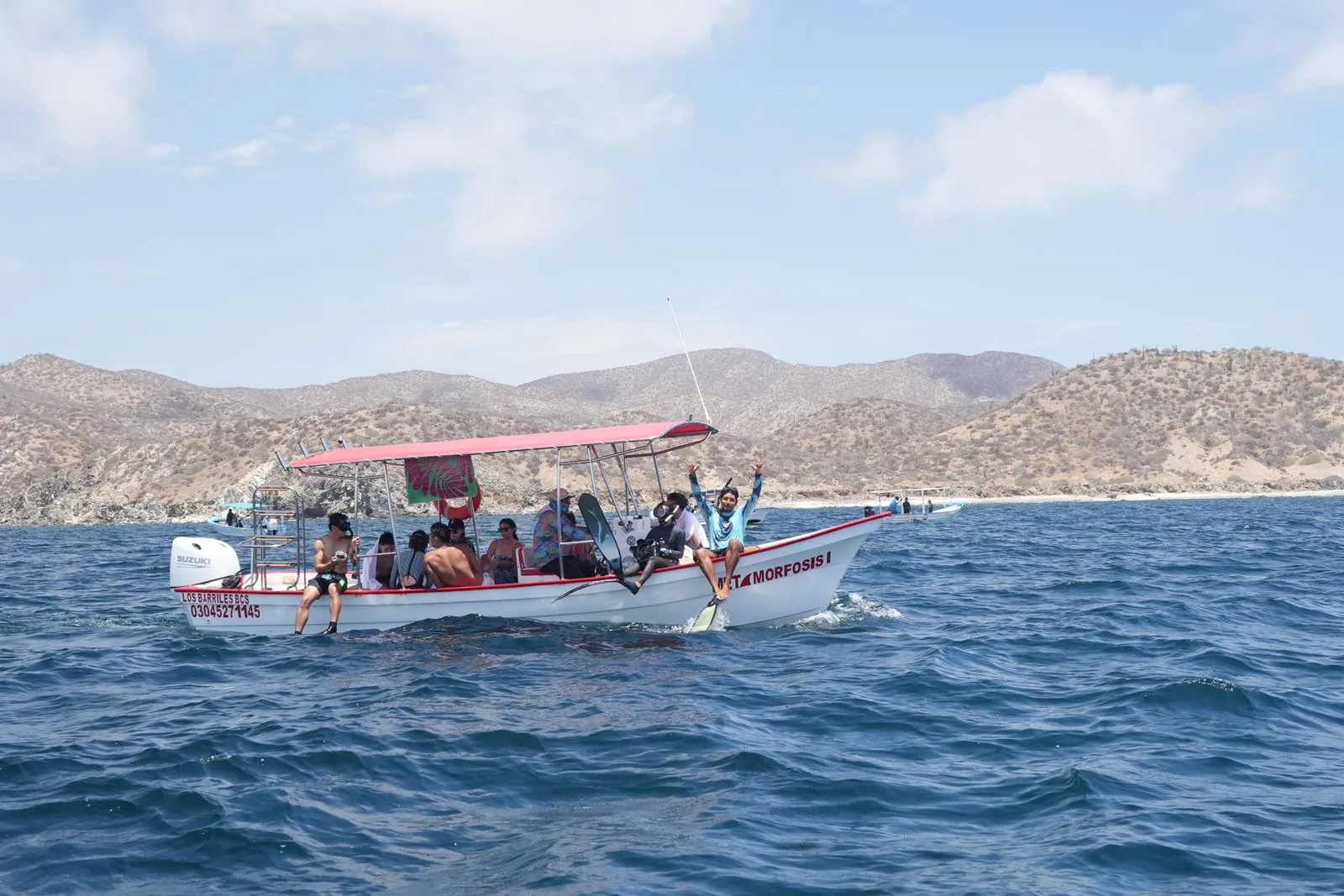
At Con Gorra, the whale shark is part of the winter season in the Bay of La Paz, as a group snorkel activity. As with any wild animal, no operator can guarantee an encounter: real presence depends on the season, the year, and the authority’s own call if few individuals are detected.
Swimming near one without touching or chasing it is not just courtesy — it is part of the rule that keeps the activity open at all.
References to keep exploring
- Hilbourne et al. (2016) · 4th International Whale Shark Conference · Atmospheric and oceanographic impacts on whale shark (Rhincodon typus) seasonality in the Bay of La Paz, Mexico
- Revista Mexicana de Biodiversidad · Whitehead et al. (2020) · The influence of zooplankton communities on the feeding behavior of whale shark in Bahia de La Paz, Gulf of California
- CONANP / SEMARNAT · Management plan for the whale shark in the Bay of La Paz
Sources accessed on 8 November 2026. Editorial text by Con Gorra Expeditions.