Before you travel
Traveling solo on an open group trip: what science found about doing something new with strangers
Joining an expedition alone with people you’ve never met sounds, in theory, uncomfortable. Research on talking to strangers suggests most of us misjudge how well it actually goes.
We misjudge whether we’ll enjoy talking to strangers
In 2014, psychologists Nicholas Epley and Juliana Schroeder published a series of experiments with hundreds of people commuting on public transport — trains, buses and taxis. One group was asked to talk with the stranger sitting next to them; another to commute in silence as usual.
Before the commute, most people predicted they’d prefer silence. By the end, the opposite happened: those who talked to a stranger reported the most pleasant commute of the three groups, and those who stayed silent reported the least pleasant. The effect held for introverts and extraverts alike.
The authors’ explanation isn’t that talking is always better than silence — it’s that we tend to misjudge how interested a stranger is in talking with us, and so we avoid an interaction we would probably enjoy.
An old concept for a familiar feeling
Anthropologist Victor Turner coined the term communitas to describe the spontaneous sense of unity that can arise among people who, without knowing each other, go through an out-of-the-ordinary experience together. It is a social-science concept, not a lab-measured law, and it’s worth treating it as such.
A more recent, concrete application of the idea came in 2018, when researchers published a study in Annals of Tourism Research on airport passengers: they found that sense of community among strangers appears when people look out for or help one another within a shared, relatively secure environment. An airport isn’t a boat in the Sea of Cortez, but the logic — strangers sharing a parenthesis outside their routine — is similar.
Why social connection matters, beyond the trip itself
A review of 148 separate studies, published in 2010 with data from more than 300,000 people, found that people with stronger social relationships were, on average, about 50% more likely to still be alive over the period studied than people with weaker ones — an effect the size of quitting smoking or heavy drinking.
This doesn’t mean a single trip with an open group will change your health. It means social connection, in general, matters more than we tend to assume, and that any practice that nudges you toward talking to new people — even once — draws on that same foundation.
A short trip already does something measurable, with company or not
A controlled trial with 40 German-speaking middle managers found that a single four-night getaway — away from home or even staying home — had large, immediate effects on perceived stress and well-being, still measurable 30 and 45 days later. The environment mattered less than expected.
In other words: part of a trip’s benefit doesn’t depend on who you’re with. What this article’s research adds is that the social part — even with people you just met — may add something on top, not subtract from it.
What this means for an open group
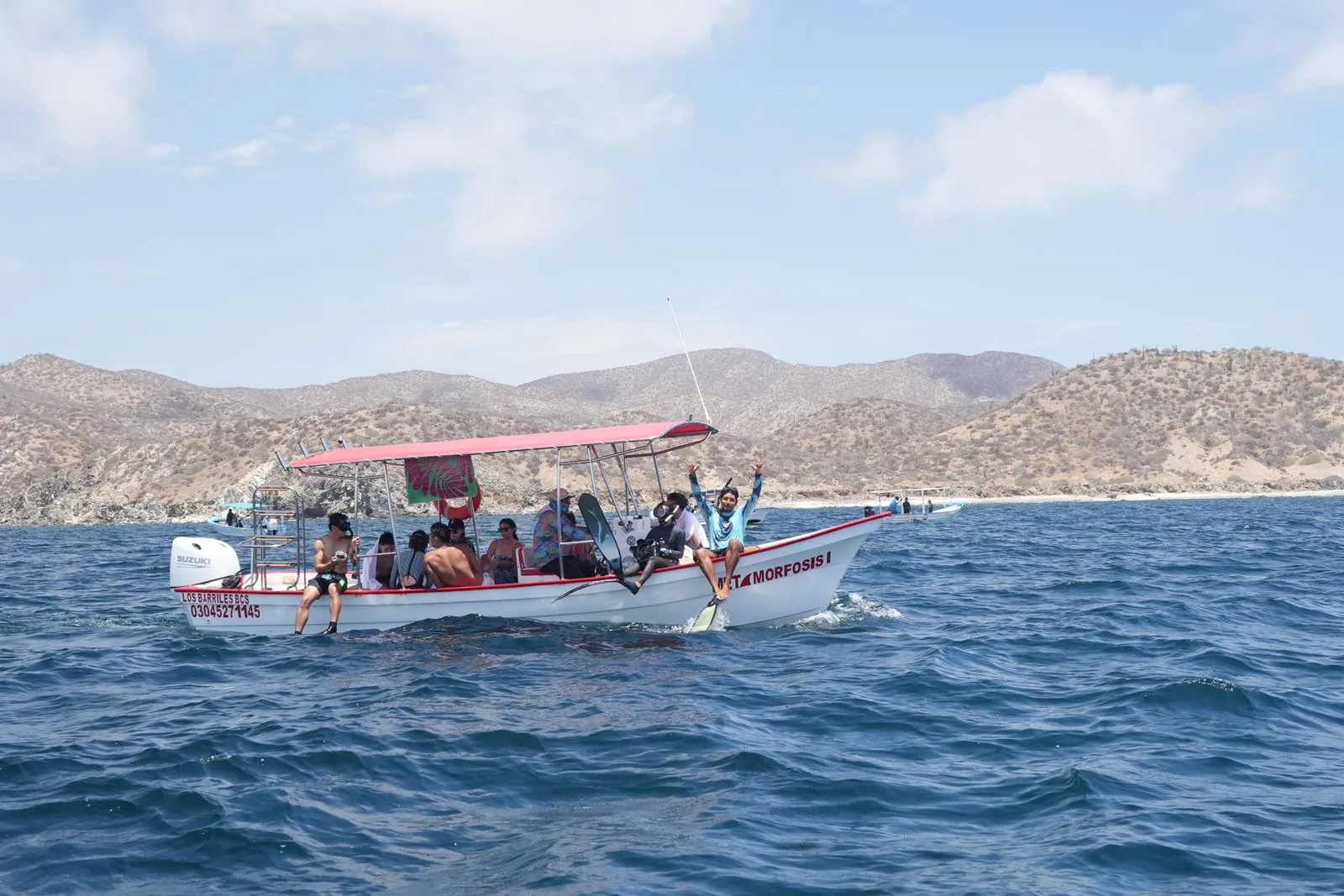
At Con Gorra, several expeditions — like the Sardine Run or the seasonal gray whale and humpback departures — run as open groups: people who book on their own and share the experience with whoever else signed up that day. No one promises you’ll make a lifelong friend; no one needs to, for the science to suggest you’ll probably enjoy the conversation more than you expect before stepping onto the boat.
References to keep exploring
- Journal of Experimental Psychology: General · Epley & Schroeder (2014) · Mistakenly seeking solitude
- Annals of Tourism Research · Huang, Xiao & Wang (2018) · Airports as liminal space
- PLoS Medicine · Holt-Lunstad, Smith & Layton (2010) · Social relationships and mortality risk: a meta-analytic review
- International Journal of Environmental Research and Public Health · Blank et al. (2018) · Short vacation improves stress-level and well-being in German-speaking middle-managers
Sources accessed on 8 November 2026. Editorial text by Con Gorra Expeditions.